

New Tech Exit Resources for Schools
Plus other resources on AI and parenting

Schools play such a pivotal role to help provide a positive phone-free community and facilitate collective solutions to help parents opt out of and delay smartphones altogether. To help support schools in their work, last week I released two new Tech Exit resources specifically for schools:
A toolkit with five key actions that schools can take to protect students from digital harms.
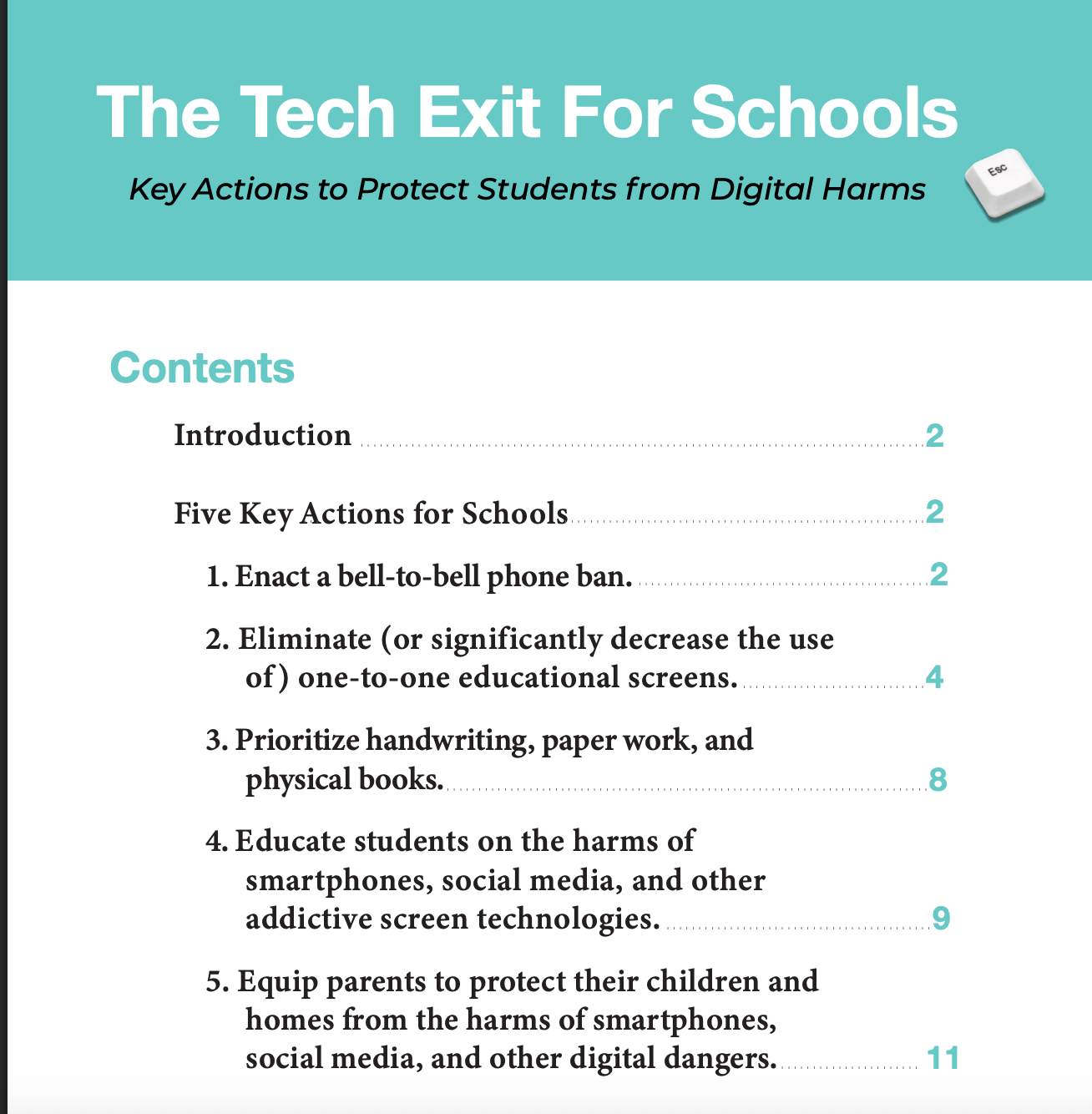
And a letter template that schools can personalize and send to their parents to educate and encourage their communities of families to delay smartphones and social media for children and teens outside of school hours.

They are both available on EPPC’s website as downloadable PDFs, along with other resources for schools.
Please share these with any educators, school administrators, school boards or superintendents, or networks or associations of schools that you know to help them protect students from screen-based harms.. Releasing these now, I hope they help schools plan effectively over the summer for the next school year.
Resources on AI and Kids
For those who may have missed it, at the end of last year I put out a Substack post about what parents should know about the AI revolution coming for our kids:
I recently expounded on the themes of that post in an in-depth talk about the harms of AI to kids and what parents can do to protect them. You can watch it here:
I also participated in a new podcast special on AI and parenting from The Gospel Coalition (TGC) that you can listen to. It’s called “‘Not a Child-Safe Technology’: Proactive Parenting in the Age of AI.”
More Coverage on How Digital Tech is Impacting Marriage and Fertility
Following the report EPPC released by me and Chloe Lawrence a few weeks ago on how digital technologies (smartphones, social media, porn, and AI companions) are harming human relationships and negatively affecting America’s rates of sex, marriage, and fertility, I wrote a piece in the Daily Signal about how as MAHA proactively addresses root health causes of the rising infertility crisis in our country, that it pay attention to the hidden health hazard of what is happening to young people behind screens.
I also did an interview with the Washington Watch about the report and op-ed here:
Positive Momentum Growing
To end on a positive note, I have never been more encouraged about the incredible cultural shift we are seeing right now against screens during childhood. Just in the last few months we have seen:
The first guilty verdict for social media companies for their products’ harms to an individual plaintiff in March. (You can read my fuller analysis of the verdict and its significance in Fox News and a Letter to the Editor in The Wall Street Journal in response to their Editorial Board’s analysis of the verdict.)
The Office of the Surgeon General at HHS released its first-ever advisory on kids’ screen use. While the Biden Administration’s Surgeon General issued an advisory on teens and social media, this is the first advisory to address more broadly the harms of interactive screens to all ages of children and teens. And critically the advisory aligns with The Tech Exit’s message to delay the introduction of screens for as long as possible. Truly historic. I offered my comments on the significance of this advisory in an article here. I hope this is just the first step, and that this Administration, and specifically the Department of Health and Human Services, continue to do more on this important issue.
Disney Pixar is releasing Toy Story 5 on June 19, the plot of which is all about toys taking back a child’s attention from an iPad. Incredible to see Hollywood recognizing how the screen-based childhood has taken over and speaking into it positively, to encourage a return to real play.
Several states have passed laws to limit screen time in the classroom just this past year. Another major shift. That it’s not just about getting phones out of the school day from bell-to-bell but that now states and school districts are taking on the Ed Tech 1:1 screens on students’ desks to majorly curtail their use.
Other significant social media laws passed in new states this year and Florida’s social media ban for minors under 14 has recently taken effect, so it will be interesting to follow its enforcement against social media platforms.
This is wonderful. I wonder if you’d consider writing a similar letter template for parents who want to urge their school or district administrators to consider taking these steps?